

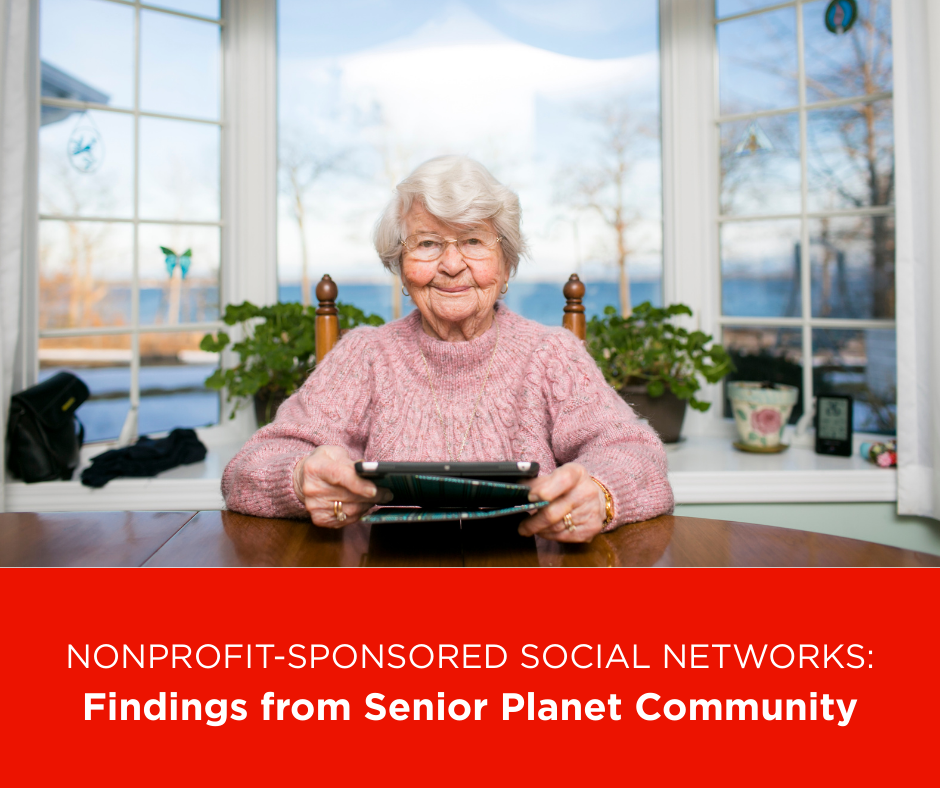
What if the internet could feel less like a maze and more like a welcoming town square? That’s the question the Senior Planet Community (SPC) white paper Nonprofit-Sponsored Social Networks: Findings From Senior Planet Community invites us to consider. SPC isn’t just another online platform—it’s a space designed with older adults at the center, a place where technology serves people, not profit. And as the white paper explores, when safety, accessibility, and purpose guide design, something remarkable happens: older adults don’t just navigate digital spaces—they thrive in them.
The platform’s approach is refreshingly simple. It’s free from advertising, free from distraction, and free from the pressures that dominate mainstream platforms. Users aren’t products to be mined—they are the heart of the community. The platform grows not through algorithms or marketing gimmicks but through the voices of the people who use it. They shape the experience, keep it relevant, and ensure it remains authentic.
What’s equally surprising is how efficiently the platform came to life. The white paper details a project built quickly, without costly custom development, using existing tools and plug-ins. It’s proof that creating senior-first online spaces doesn’t require enormous budgets—just intentional design, a clear mission, and a commitment to inclusion. And with sustained support, SPC’s model could scale to reach millions more older adults hungry for connection, learning, and community.
The implications go beyond any single platform. For seniors, SPC is more than a website; it’s a safe harbor in a digital world that often feels overwhelming. For nonprofits, funders, and policymakers, it offers a blueprint: digital equity is not only necessary, it is achievable. And for society at large, it’s a reminder that when design centers people over profit, technology can serve as a force for belonging, empowerment, and independence.
The white paper reads less like a technical report and more like an invitation. It challenges us to imagine a future where online communities are welcoming, intuitive, and deeply human. SPC is already showing the way. The question now is, how will we follow? How can we ensure that the digital world grows not only in connectivity but in care, creativity, and community?
It’s not just a success story—it’s a call to rethink what’s possible. For anyone interested in the next generation of senior-focused digital spaces, Nonprofit-Sponsored Social Networks: Findings From Senior Planet Community is worth a read. It offers inspiration, practical guidance, and, above all, a vision: a digital world where older adults are not left behind, but lifted up.